Introduction
When media narratives shape public perception and political discourse, understanding how news organizations interact with one another is crucial. This study presents a network analysis of mentions between the top 20 English-language media organizations during May 2025, with a specific focus on U.S. political coverage
The network graph collects articles on US Politics published in May 2025 among the top 20 English-language media organizations [1], using the News API. The limitation of this search is that only the mentioning of the media’s official names are recorded (eg. mentioning of Associated Press in short forms like “AP” is not counted). However, the general observation can still provide an insight of the media dynamics for US politics news.
The finding is that a few dominant outlets like CNN and TIME serve as central hubs of influence, while others form distinct editorial clusters or remain isolated. This research reflects the structural dynamics, influence hierarchies, and editorial clusters that define the contemporary media ecosystem.
Finding
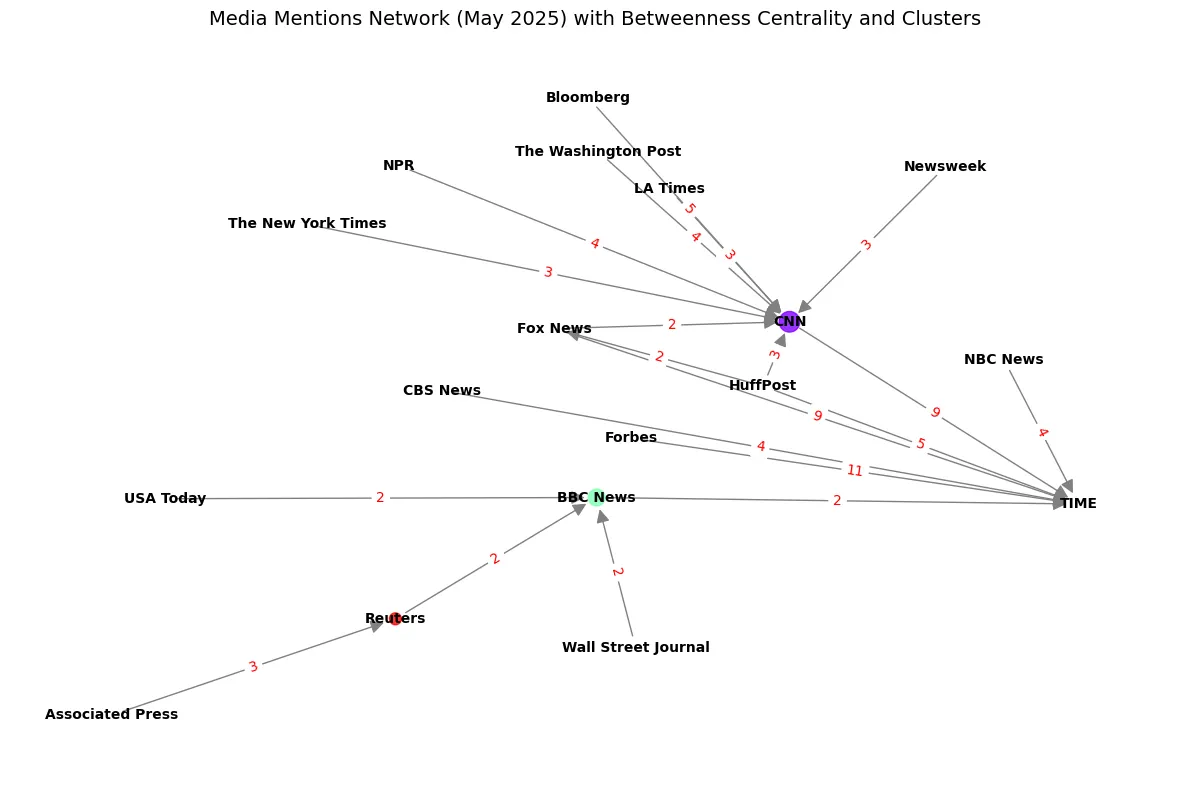
An overview of the network graph suggests a centralized structure where a few outlets like TIME and CNN dominate the discourse. The Nodes represent the media outlets; Edges represent the directed connection showing one outlet mentioning another; Edge Labels indicate the frequency of mentions. The distribution of the mentions are not even, indicating the different level of inter-influence across the news industry.

TIME is the most frequently mentioned outlet, with multiple incoming edges (44 mentions in total), while HuffPost and Fox News are active mentioners, citing multiple other outlets. Forbes also contributes significantly to mentions, especially toward TIME (11 times).


Echoing with the Barcharts (figure 2), CNN is a major hub in this network which does both mentioning others and being mentioned. It is frequently mentioned by outlets like HuffPost, Bloomberg, LA Times, and The Washington Post; It also mentions others, including TIME, Fox News, and NBC News.
The core nodes like CNN and TIME serve as key intermediaries, facilitating information flow, connecting other media outlets, which make them the bridge or even the agenda-setter — CNN mentioned TIME for 11 times, suggesting a strong directional link; Meanwhile, HuffPost mentioned CNN for 9 times, showing its frequent reference to CNN’s reporting. Another strong connection lies between NBC News and TIME in which the fronter mentioned TIME for 7 times. The directionality of mentions shows influence patterns — CNN and TIME’s reporting is influential to other media outlets.
Analysing the centrality of the network, we can observe some clusters preliminarily. There are dense incoming and outgoing edges around CNN, and many incoming edges pointing to TIME. It suggests a potential echo-chamber between several media outlets, while outlets like Reuters and Wall Street Journal appear on the edges of the network with fewer connections. The peripheral nodes may represent a more specialized or less cited approach of reporting of US politics.


We used the Girvan-Newman algorithm and detected five communities by removing edges with high betweenness. Each cluster represents a group of media that frequently mention each other, suggesting potential grouping on the media outlets’ ideologies, journalism styles or target audience. Some studies may discuss the media alliances or polarization of political context between the groups. Unlike CNN, despite being the most mentioned, TIME has zero betweenness, suggesting it is a target of mentions but not a connector.

Cluster 0 consists of members like CNN, The Washington Post, Bloomberg, LA Times, NPR and Newsweek. They are frequent mentioners and moderately mentioned, which likely represents the mainstream of political coverage.
Cluster 1 consists of TIME, Fox News, NBC News, CBS News, HuffPost and Forbes. This group is less distinctive: Fox News and HuffPost are ideologically distinct, but both cite TIME and others in this group; Also, the cluster includes both legacy broadcast media and digital-first platforms.
Cluster 2 includes BBC News, USA Today and Wall Street Journal, which is a smaller cluster with international and business-oriented outlets, with less frequent interaction with U.S.-centric political outlets.
Cluster 3 is the isolated The New York Times alone. It may be underrepresented due to the dataset’s threshold or citation style, but the isolation may suggest its potential role as a primary source than a citer.
Cluster 4 involves Reuters and Associated Press. Both are wire services that provide content to other outlets, which are mentioned modestly but do not cite others much. This cluster likely represents news originators — they produce content that others use, but they themselves don’t engage in citation-heavy reporting.
From Cluster 0 to Cluster 4, the map highlights different functions of the media outlet in the news coverage. While CNN and Times are frequently the sources of information, other outlets in cluster 0 and 1 are responsible for amplifying it.
Conclusion
The network graph of media mentions shows the influence pattern between the top media outlets. It points out that the major hub of information is located at CNN and TIME, which emphasizes both the potential risks and responsibility of news media in sourcing. The finding of the clusters hint at the existence of media echo chambers, editorial alignment or content syndication, which reminds us of the importance of impartiality and independence in journalism.
[1] https://prlab.co/blog/50-leading-media-outlets-for-news-coverage-in-2025/
Collab link: https://colab.research.google.com/drive/1gJ05RosxTF-EipKtOT_0IpeoFxnkVSfh?usp=sharing

Leave a Reply